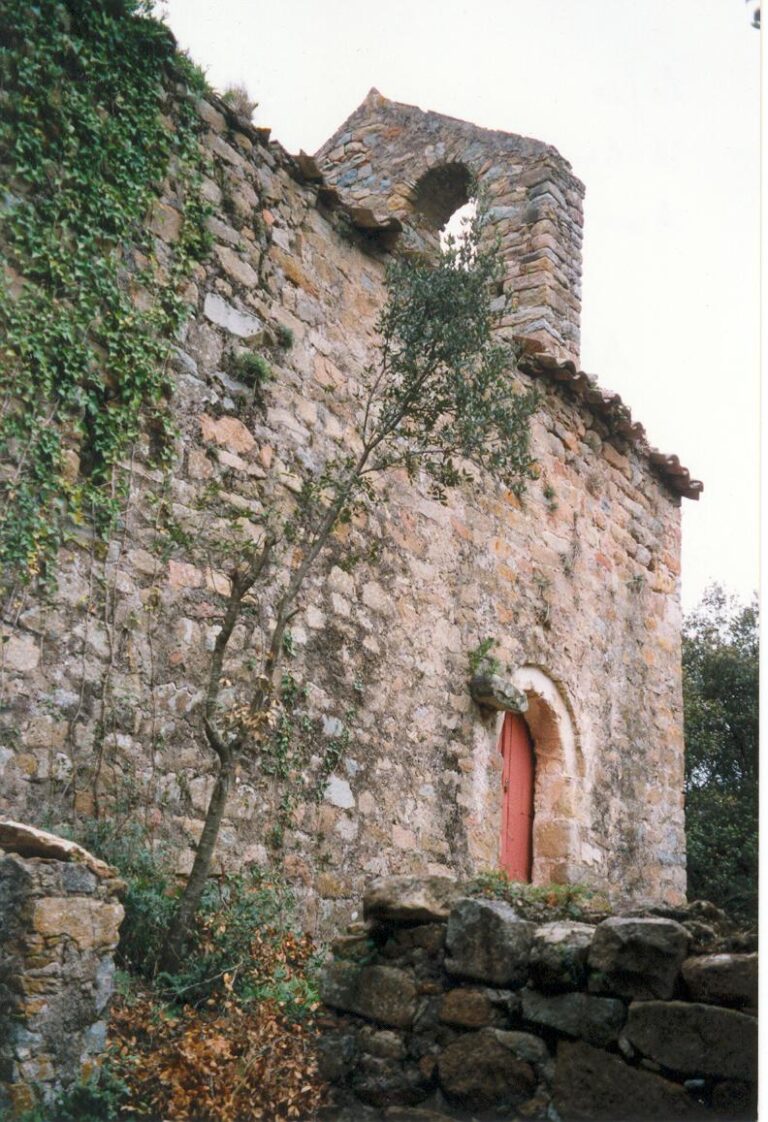
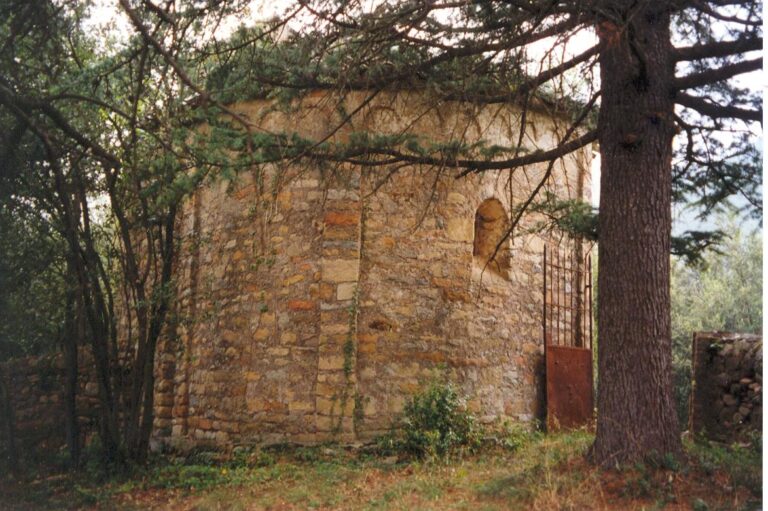
Sant Agustí in Lloret Salvatge was a medieval settlement and former parish that is no longer used for worship. The chapel was initially dedicated to Sant Julià. It is surrounded by the farmhouses of Can Sitges, Can Puig de Lloret Salvatge, La Gultresa and Can Roure.
Originally, it was a Romanesque building with a single nave and a semicircular apse, externally decorated with the characteristic Lombard bands and blind arches of the 11th century. The earthquakes of 1427, whose epicentre was in Lloret Salvatge, caused the nave to collapse. Thanks to its compact structure, the Romanesque apse withstood the disaster. The walls and vault were rebuilt in the 16th century. It was then that the entrance was placed in the north wall, an unusual arrangement in religious buildings. A bell gable was later erected above the roof ridge. Behind the apse once stood the enclosure of the former cemetery.
Until the beginning of the 20th century, the church housed a venerated 13th-century polychrome wooden statue of the Mother of God, which has since disappeared. The old stone font also disappeared a few years ago, and only its base remains inside. Since 2018, work has been under way to restore and recover the church and its archaeological surroundings, a highly unusual medieval complex in Catalonia.





Subscribe to the newsletter





Recovery, Transformation and Resilience Plan – Funded by the European Union – NextGenerationEU



Local Development and Employment Officer (AODL) within the new tourism management model for La Selva. Initiative subsidised by the Public Employment Service of Catalonia as part of the Local Development Support Programmes.