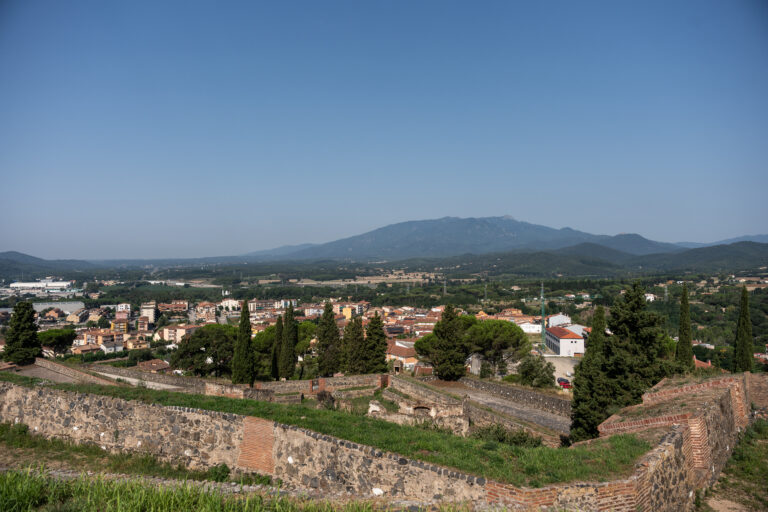
The Puigmarí Tower was erected around 1944 as a key element in the extensive communications network conceived by the Spanish government to enhance connectivity throughout the country. This construction was part of an ambitious project that deployed hundreds of towers along the Catalan coastline, from Sant Carles de la Ràpita to La Jonquera, with the purpose of enabling optical telegraphy. Despite this effort at advancing communications, the technical advantages of these facilities were short-lived, as the arrival of electrical telegraphy soon made them obsolete. Number 212 in this network, the Puigmarí Tower is located at a strategic point at an altitude of 236 metres above sea level. The nearest neighbouring towers are Montagut, 11.6 km away, and Puigsardina, 6 km away. The layout and location of these towers were entrusted to Ildefons Cerdà, renowned as the architect of Barcelona’s Eixample district. This fact emphasizes how an integrative and forward-looking vision was considered important to the implementation of communication infrastructures at the time. Afterwards, only the base of the tower remained, hidden by earth and vegetation that had accumulated over the years, but initial excavations revealed it in a fairly acceptable state of preservation. At the top of the hill there had been a primary geodesic vertex (a triangulation station, or trig point, used for calculating long distances and positions), which was removed for the reconstruction of the tower. Once the rebuilding was complete, the trig point was replaced on the roof. Curiously, this tower was popularly known as the Torre del Rellotge (Clock Tower), although the reason for this is not known.




Subscribe to the newsletter





Pla de Recuperació, Transformació i Resilência - Finançat per la Unió Europea - Next Generation UE



AODL en l\'ámbit del Patrimoni. Acció subvencionada pel Servei Públic d\'Ocupació de Catalunya en el marc dels Programes de Suport al Desenvolupament local.