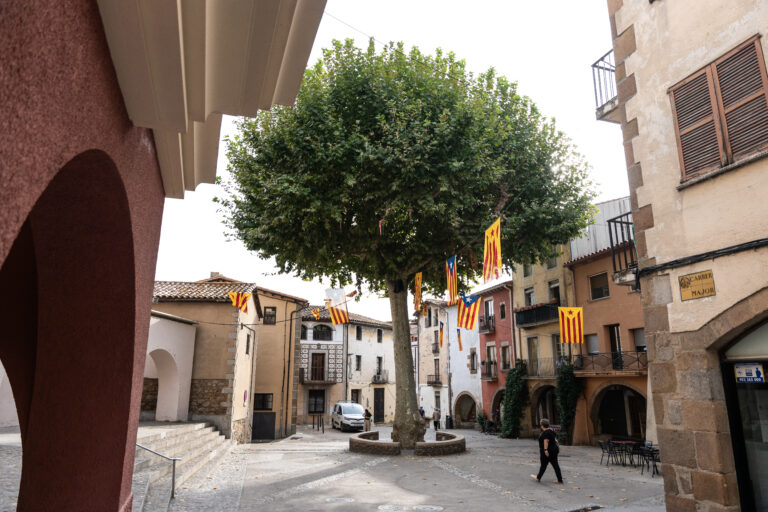
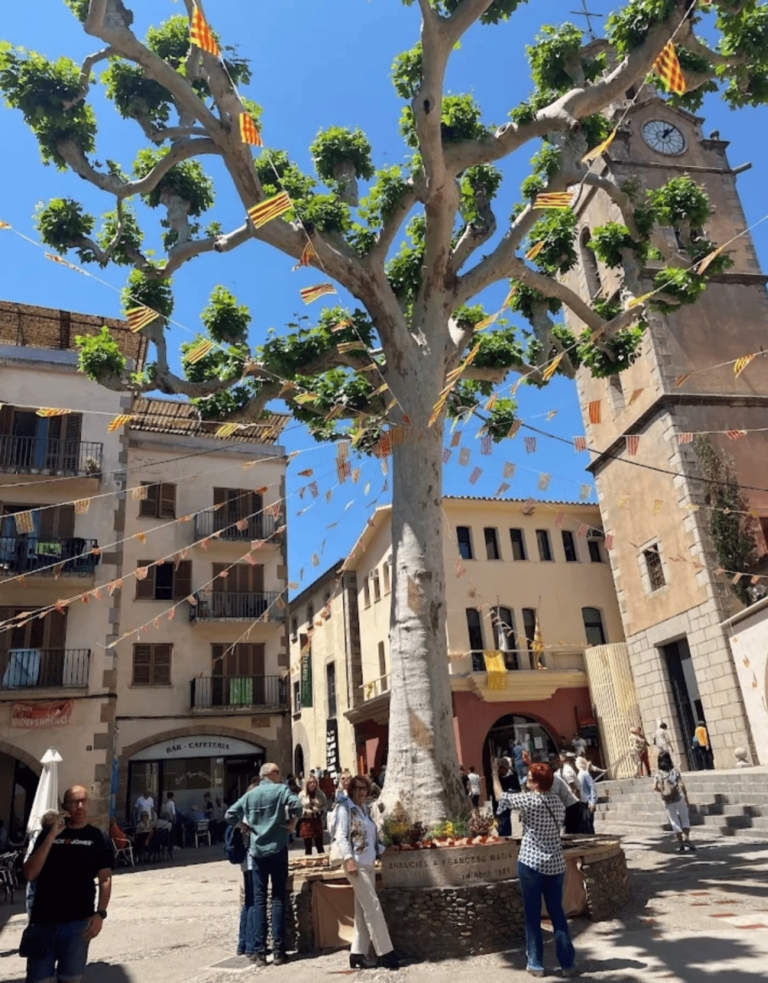
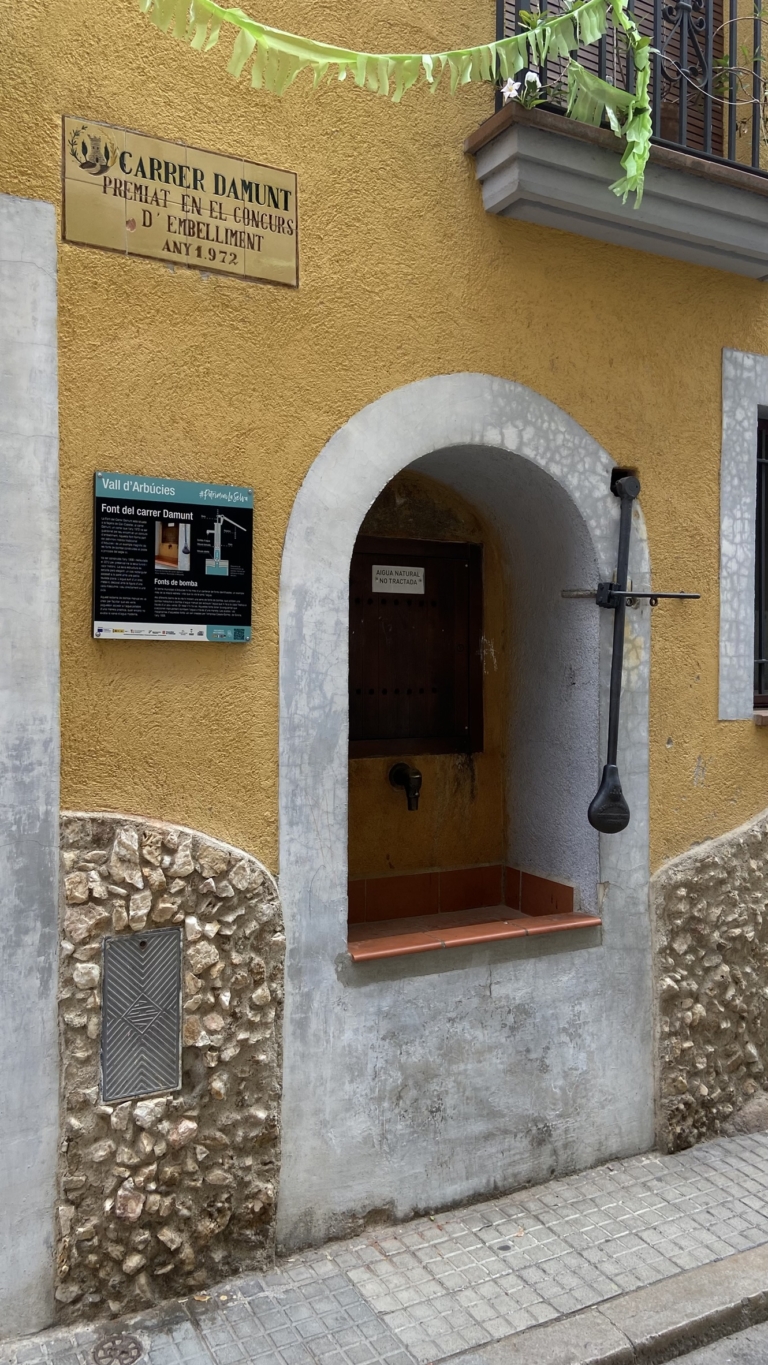
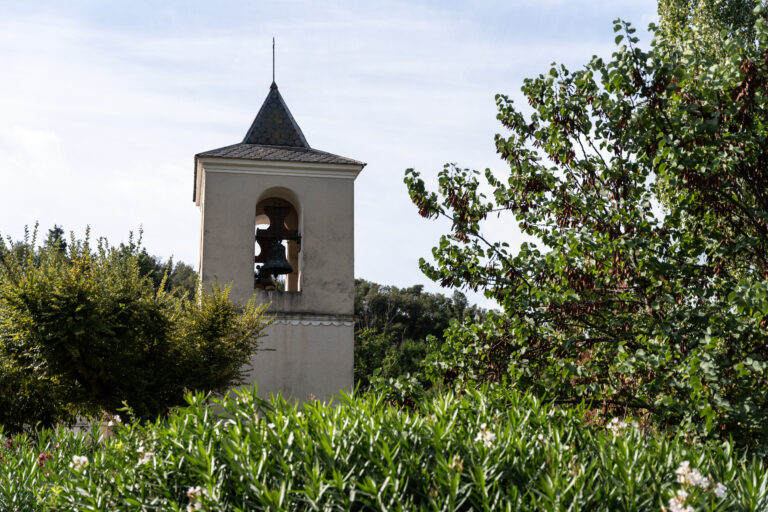
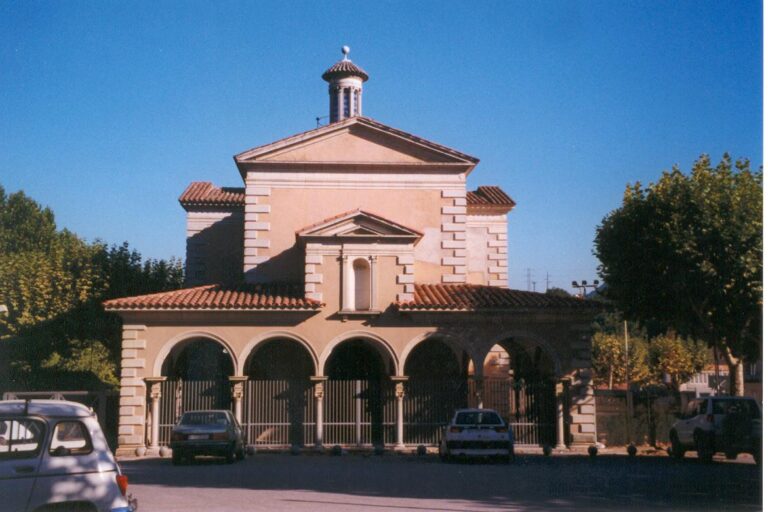
The Plaça de la Vila—literally “Town Square”—is the centre of the old town of Arbúcies. From the 10th century until the 19th century it served as the parish cemetery. Then from the second half of the 19th century, after the cemetery was moved, it was used as a location for public events. Around the square stand some of the oldest buildings in the town, including the church of Sant Quirze i Santa Julita, the porticoes on the square, La Gabella, Cal Notari, and the imposing Arbre de la Plaça de la Vila (Tree of the Town Square), also known as the Arbre de la Llibertat (Tree of Liberty), which presides over all. Parish church of Sant Quirze i Santa Julita The primitive parish church of Arbúcies was consecrated in the year 923, but the current building corresponds to a construction dating from the early 17th century, subsequently extended and modified during the 17th, 19th and 20th centuries. It is a temple of a single nave covered with a ribbed vault and a polygonal apse, with an octagonal bell tower that was rebuilt in 1959.
The porticoes
The square has porticoes of semi-circular arched vaults of different sizes, which correspond to the ground floors of the surrounding houses. These vaults and the houses were built in the 16th century. In the past, the weekly market and fairs were held in this porticoed area.
La Gabella
La Gabella is a late Gothic-style manor house documented from the 17th century, which over the years has been used as a warehouse and shop and, later, also as a guesthouse and dwelling. In 1970, the house was acquired by the municipal council and it is now the headquarters of the Museu Etnològic del Montseny (MEMGA—Ethnological Museum of Montseny, La Gabella).
The name of the house comes from the term gabella, which was an ancient tax levied on certain staple foodstuffs. A warehouse where goods subject to this tax were stored was also called a gabella.
The building, similar to other late Gothic buildings in Arbúcies, has a square floor plan, with a ground floor, a mezzanine and two upper floors, sheltered under a hip roof. The main façade features a semi-circular voussoired doorway and several quadrangular windows with monolithic lintels. It is believed to have been constructed by the master builders of the Brull family, who were responsible for other houses, churches and mills in the Arbúcies area The Arbre de la Plaça, or Arbre de la Llibertat (Tree of Liberty) In the very centre of the town square stands one of the symbols of Arbúcies, the Arbre de la Plaça (Tree of the Town Square), also known as the Arbre de la Llibertat (Tree of Liberty), declared a monumental tree by the Generalitat de Catalunya (Government of Catalonia) in 1990. The tree, which provides shade to the square, has been a source of inspiration for many painters and poets over the years. The exact date of its planting is unknown, although according to Víctor Balaguer it was planted to commemorate the Glorious Revolution of September 1868. Others claim that it was planted in 1873 to commemorate the proclamation of the First Republic and as a symbol of freedom.
“[…] and, rising up, magnificent, on tiptoes,
it is once again the Tree of Freedom.”
(Rafael Vilà i Barnils [transl. from Catalan])
Subscribe to the newsletter